- Telephone
- Email

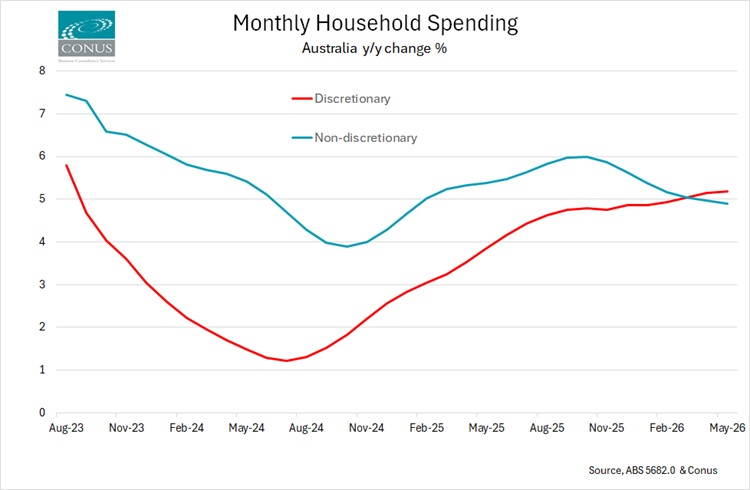
The latest ABS Monthly Household Spending Indicator (May 2026) confirms a milestone worth pausing on. Discretionary spending growth crossed above non-discretionary in March, the first time that has happened in this cost-of-living cycle, and the gap has widened in each month since. By May, Trend discretionary spending was up 5.2% y/y nationally against 4.9% for essentials.
That crossover is the end point of a long grind rather than a sudden shift. Trend discretionary growth bottomed out at just 1.2% y/y in July 2024 and has climbed steadily for almost two years. Growth in essentials, meanwhile, peaked at 6.0% in October 2025 and has decelerated for seven consecutive months. Households’ essential outlays are growing more slowly at the same time as their discretionary spending accelerates, which is precisely what an easing squeeze should look like.
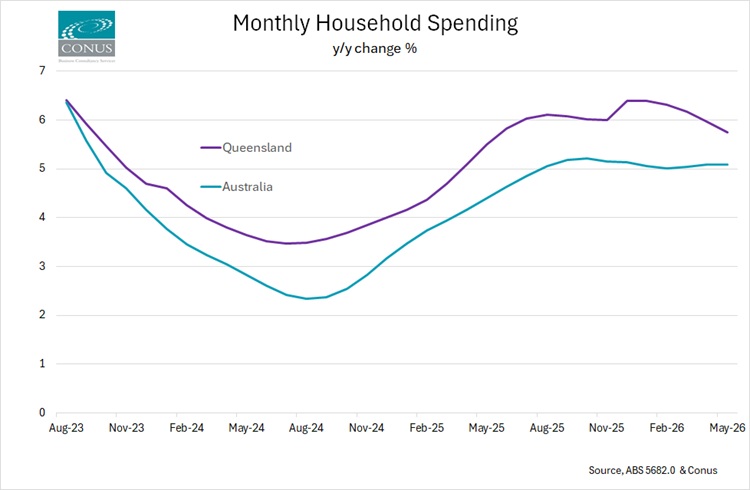
Queensland got there first, and by a wider margin. Trend spending in Queensland is up 5.7% y/y against the national 5.1%, and the State has out-grown the nation by around a full percentage point for the past year. Discretionary spending in Queensland crossed above essentials back around the turn of the year and now sits at 5.8% y/y. The real (chain volume) data tells the same story with less noise; Queensland household spending volumes rose 4.4% y/y in the March quarter against 2.8% nationally, with the national figure itself up from a barely-positive 0.4% a year earlier. Four consecutive quarters of accelerating real growth is not a blip.
A few honest caveats before anyone declares victory. The monthly discretionary and non-discretionary series are published in current prices only, so some of the rotation reflects essentials inflation (insurance, utilities, fuel) decelerating rather than a surge in discretionary volumes. That distinction matters less than it might seem; slower growth in the cost of essentials is itself the squeeze relaxing, just via prices rather than volumes. Queensland’s numbers also carry some flattery from electricity rebates rolling off, which mechanically boosts measured spending on essentials against a rebate-suppressed base. The cleaner test is discretionary spending alone, where rebates play no part, and Queensland still leads the nation there. And with Queensland’s population growing faster than the national average, the per-capita gap is narrower than the headline one, although it does not disappear.
For Far North Queensland the implications are direct. Ours is a discretionary-heavy economy; tourism, hospitality and (much of) retail all live off the portion of the household budget that gets cut first when essentials bite. A sustained rotation of spending growth back towards discretionary categories, led by this State, is about the most encouraging signal these businesses have seen in the data for several years. One or two crossover months proves little on their own, but a 22-month climb in discretionary growth, seven months of easing growth in essentials, and four quarters of accelerating real spending all point the same way.
 We are proud to have CBC Staff Selection as supporters of the Conus/CBC Staff Selection Trend Employment and Jobseeker data series