- Telephone
- Email

In this blog we decompose population growth in the Cairns Statistical Area Level 4 (SA4) into its three drivers (natural increase, net internal migration and net overseas migration) over the eight years to 2024-25. The aim is to establish how the region’s growth is actually generated, and how that composition has shifted through the COVID period, so the regional picture can be read against the Queensland state aggregate rather than inferred from it.
Date and Method
The Cairns SA4 is constructed from the ABS Regional Population release by aggregating its 33 constituent SA2s across five SA3s (Cairns – North, Cairns – South, Tablelands (East) – Kuranda, Innisfail – Cassowary Coast, and Port Douglas – Daintree). This is the populated Far North Queensland core. It excludes Cape York and the Torres Strait, which fall within the separate Queensland – Outback SA4.
A comparable decomposition runs from 2017-18, the point from which the ABS rebuilt its regional internal migration estimates on a consistent basis. A 2021 Census rebase and the move to the 2021 edition of the statistical geography separate the 2020-21 and earlier figures (on the 2016 base) from 2021-22 onward. The Cairns SA4 footprint is stable at 33 SA2s throughout, so the comparison holds at SA4 level, but the seam should be kept in mind when reading absolute levels across it.
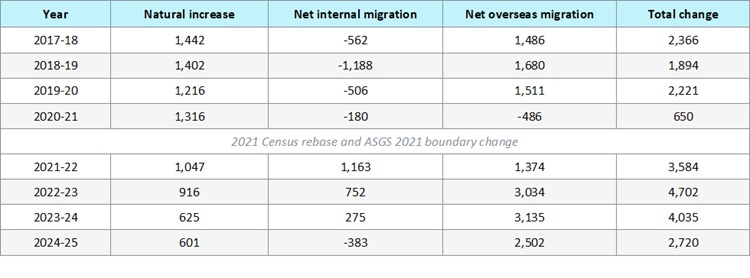
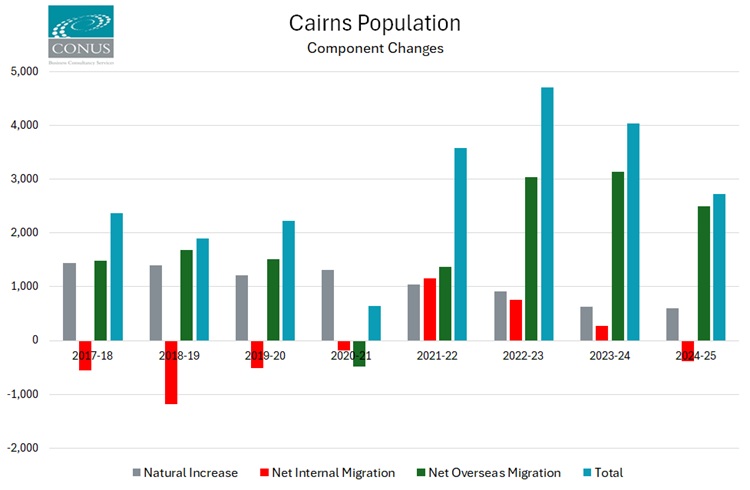
Net internal migration is the component that reframes the series. It was negative in every pre-COVID year, a net loss averaging around 750 persons annually, briefly and sharply positive during the pandemic (a net gain of over 1,100 in 2021-22), and has now returned to net loss. Cairns is, and has long been, a net loser of population to the rest of the country on internal migration. The pandemic interruption was the anomaly, not the recent negative reading.
Net overseas migration is the region’s principal growth engine, and was so well before COVID, running steadily at roughly 1,500 to 1,700 persons a year. It turned negative under closed borders in 2020-21, surged past 3,000 following the reopening, and is now moderating toward, though still above, its pre-COVID rate.
Natural increase is in clear secular decline, from around 1,400 persons a year before COVID to about 600 now. Birth and death registration data is largely unaffected by the rebasing, so this is a genuine structural shift, consistent with the ageing-population and lower-births pattern evident in the state data.
Summary
 We are proud to have CBC Staff Selection as supporters of the Conus/CBC Staff Selection Trend Employment and Jobseeker data series