- Telephone
- Email

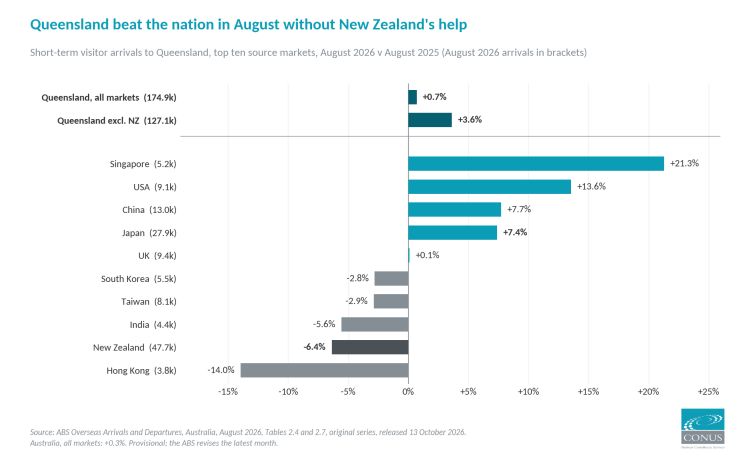
The ABS overseas arrivals data for August came out last week. Short-term visitor arrivals to Queensland were 174,860, up 0.7% on August 2025, against 0.3% for Australia. Nationally, visitor arrivals are still 4.3% below August 2019.
That is a narrow lead and Queensland was fourth of the eight states and territories, behind the Northern Territory, South Australia and Victoria. What matters is where the lead came from. In July, all of Queensland’s outperformance was New Zealand. In August New Zealand arrivals to Queensland fell 6.4% to 47,720, a steeper fall than the 3.9% nationally, and Queensland’s share of the New Zealand market slipped from 44.5% to 43.3%.
Take New Zealand out and the lead gets wider, not narrower: Queensland up 3.6% against 1.0% for Australia. Japan made the biggest contribution to that Queensland outperformance. Japanese arrivals to Queensland rose 7.4% to 27,880, against 3.3% nationally, and Queensland took 44.5% of all Japanese visitors to Australia, up from 42.8%. China and the USA also added. It was not broad-based, though: five of Queensland’s top ten markets fell, including Korea, Taiwan and Hong Kong.
The ABS does not split these figures below the state level, so there is no TNQ number in them. The nearest local read we have is Cairns Airport, where international passengers were up 17.9% in August (we are waiting for the release of the Airport’s September data) while domestic passengers fell 7.9%. Airport counts include residents and departing passengers, so they are not like-for-like with visitor arrivals, but they point in the same direction.
Two months, two very different New Zealand stories. These are single-month original figures, so we would not read a trend into either of them just yet. The question for the TNQ is whether the Japanese strength is reaching the region, and that needs the regional visitor surveys rather than border counts.
 We are proud to have CBC Staff Selection as supporters of the Conus/CBC Staff Selection Trend Employment and Jobseeker data series