- Telephone
- Email

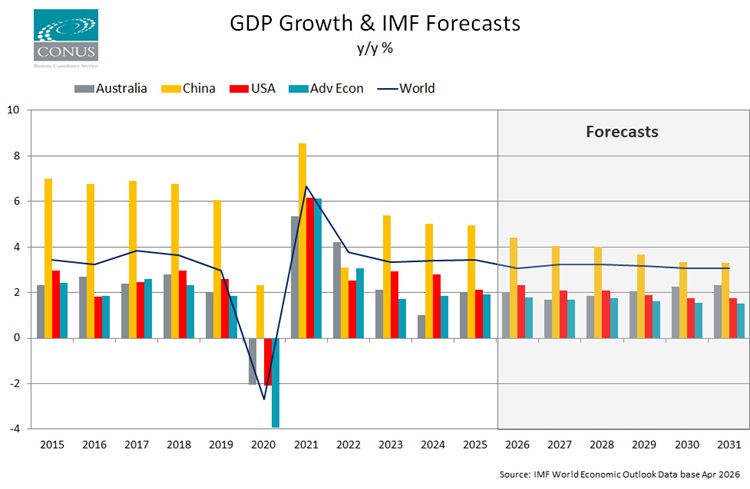
The IMF has taken 0.1 ppts off its 2026 global growth forecast, to 3.0%. That is the entire cost, measured at the global aggregate, of the biggest interruption to oil supply the market has seen. The July World Economic Outlook Update also lifted 2027 by 0.2 ppts to 3.4%, which leaves the two-year picture essentially where it sat in April. The first chart shows why that looks so unremarkable: world growth has been a flat line near 3% for a decade, and the IMF expects it to stay there out to 2031.
The flat line hides a lot. Gulf oil production fell by almost 14 million barrels a day between January-February and the March-May period, and yet the country-level revisions run in both directions. Saudi Arabia was cut by 1.4 ppts, Türkiye by 0.5, Canada by 0.4 and France by 0.3. South Korea was revised up 0.7 ppts, despite importing most of its energy through the Gulf, on the back of a semiconductor and AI hardware export boom. China went up 0.2. Two forces are pulling against each other, and where a country lands depends on its exposure to the war and its position in the technology supply chain. Iran was also revised up 0.7 ppts, to a contraction of 5.4%, which is a handy reminder that the direction of a revision tells you nothing about the level.
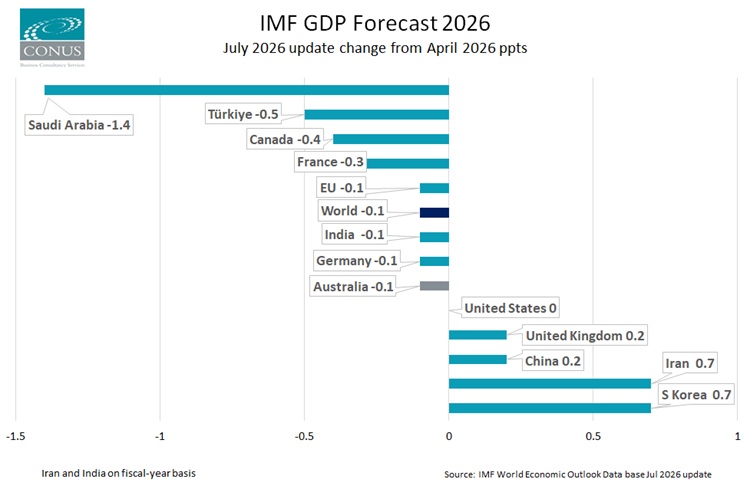
Australia got off with a 0.1 ppt downgrade, to 1.9% in 2026, and no change at all to 2027. We are a net energy exporter and the terms of trade did the work. The June Resources and Energy Quarterly from the Dept. of Industry, Science and Resources revised resources and energy export earnings up by $22 billion for 2025-26 and $42 billion for 2026-27, to $405 billion and $416 billion. LNG earnings alone go from $59 billion to $65 billion. On the Department’s reading, the wave of new supply that was set to tip LNG into oversupply has been pushed back two to three years. That reprieve is a delay rather than a reversal: LNG earnings peak at that $65 billion in 2026-27, then fall back towards $41 billion in real terms by 2030-31.
Which brings us to the part that matters up here. That windfall gets booked in the Bowen Basin and at Gladstone. Cairns does not export LNG. What Cairns gets is the cost side. Jet fuel was more than 40% higher in early June than in mid-February, and the ACCC found both major airline groups responding by lifting fares and trimming capacity, with services suspended on thin regional routes including Alice Springs to Brisbane. Virgin has put around 5% through domestic fares since March. The IMF has fertiliser prices up 26% this year, which lands squarely on cane and bananas. Queensland’s aggregate numbers will look perfectly healthy but that is a different proposition for how FNQ fares.
Yesterday’s CPI suggests the shock may be unwinding. Headline inflation eased to 3.8% in the year to June, down from 4.0% in May, with automotive fuel falling 10.9% in the month alone and annual Transport inflation down to 0.1% from 3.3%. The Trimmed Mean did not budge, holding at 3.6%. Worth noting that the ABS has excluded automotive fuel from the Trimmed Mean every month since March. Electricity is up 22.4% over the year, and that has nothing to do with Iran.
Two things to watch. The RBA meets on 11 August, holding at 4.35% after three hikes this year, and a Trimmed Mean stuck at 3.6% is not the print that delivers a cut. And the IMF’s numbers assume the Strait of Hormuz reopens from mid-July, with conditions back to normal by March 2027 (which has obviously already been proven too optimistic). That assumption came under strain within days of publication. Read the chart as a snapshot rather than a forecast you can bank.
 We are proud to have CBC Staff Selection as supporters of the Conus/CBC Staff Selection Trend Employment and Jobseeker data series