- Telephone
- Email

The ABS released its March quarter population figures this morning and the interstate migration numbers are the ones worth your time. Queensland’s net interstate migration was 14,718 in the year to March, down 39.5% on the 24,319 of a year earlier, and the lowest annual reading since the year to March 2017. The March quarter on its own was 2,491 people, the weakest single quarter since September 2015.
Step back and the scale of it is clearer. Net interstate migration peaked at 40,057 in the year to March 2022, and four years later it has fallen by 25,339 people, or 63%. That is not a wobble, it is the unwinding of the entire pandemic surge and then some. Worth remembering, though, that the surge was not the record everyone assumed at the time. Queensland took 49,962 people from the rest of the country in the year to September 1993, and sixteen annual readings beat the 2022 peak, nearly all of them between 1989 and 1995.
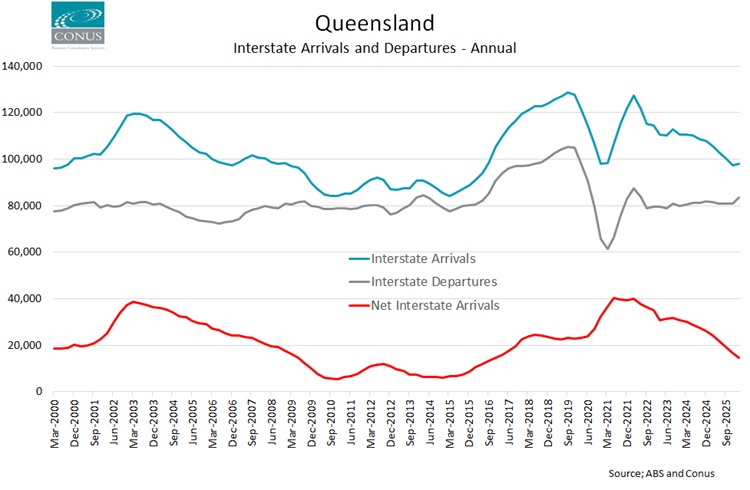
The useful question is whether that is people not coming or Queenslanders leaving, because they are very different problems. Since the 2022 peak it is almost entirely the first. Interstate arrivals have fallen 23.0%, from 127,380 to 98,121, while departures have fallen 4.5%. Fewer people arrived and slightly fewer left, so arrivals account for more than the whole of the drop in the net figure.
What is new in this release is that the second half, the departures half, of that has started to move. Over the past year arrivals fell a further 7.2% but departures rose 2.4%, the first year in which departures have added to the problem rather than cushioning it. Arrivals still do most of the work, about 79% of this year’s fall, and departures remain below where they were in 2022, so this is a turn to watch rather than an exodus. On the March quarter alone, though, departures were up 12.1% on a year earlier.
The consequence is a changed growth model. Queensland’s population still rose 1.59% over the year, to 5.74 million, comfortably ahead of the national 1.43%. But of the 90,078 people added, net overseas migration supplied 55,217 and interstate migration just 14,718. Interstate migration now accounts for about one sixth of our growth, against nearly half at the 2022 peak, and overseas migration is now close to four times its size. The growth is still there but it is arriving from a different direction, and it lands in different places.
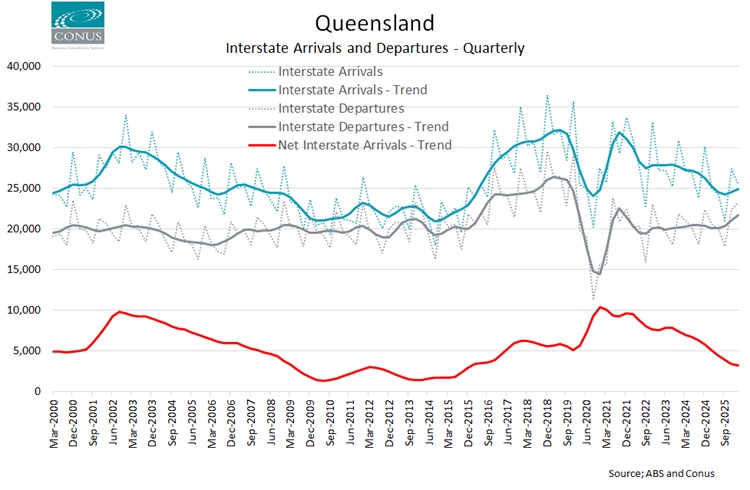
Two things stop this being a doom story. Queensland still gains more people from the rest of Australia than any other state, and only three jurisdictions are in positive territory at all. We have also been weaker than this: annual net interstate migration bottomed at 5,384 in the year to December 2010, so this is a sharp slowdown rather than uncharted ground. The frustration for us is that this release stops at the state border. There is no Cairns figure and no Far North figure in it, and the regional migration detail only arrives once a year. Whether the Far North is taking its usual share of a much smaller flow is exactly the question we cannot answer today.
Given the current focus on the Net Overseas Migration (NOM) figure, we should note that today’s release shows NOM for the year to March 2026 fell to 292,100 from 309,400 in the year to March 2025. As we write Tony Burke is speaking at the National Press Club outlining the government’s plan to reduce NOM by about 75,000 to 225,000 by 2028. While there are certainly things that a government can do to try and shift the NOM, we should also acknowledge that there are elements of the NOM over which it has no control at all!
The fact that we are talking about a ‘net’ figure provides the first clue; while government policy can influence some of the arrivals half of that equation there is next to nothing they can do about the departures half. If Aussies were to stop leaving the country (and over the past year 265,500 of them have done so) then the NOM goes up…and there is nothing a government (any government) can do about it. Even on the arrivals side of the equation there are areas where a government’s hands are tied; Kiwis can come and go freely to Australia, and over the past year about a net 30,000 of them have moved to Australia.
 We are proud to have CBC Staff Selection as supporters of the Conus/CBC Staff Selection Trend Employment and Jobseeker data series