- Telephone
- Email

On 12 June, a frontier AI model that businesses had only just begun building into their workflows simply disappeared, not because its maker chose to retire it, but because a foreign government ordered it switched off. It is a small story with a large lesson about how we now depend on artificial intelligence, and about who controls it.
The week a model vanished
On 9 June 2026, Anthropic released Claude Fable 5, the most capable model it had ever made publicly available. Just three days later it was gone. On 12 June, the United States Commerce Department issued an export-control directive placing Fable 5 and its restricted sibling, Mythos 5, off limits to any foreign national, whether inside or outside the US. Because Anthropic could not reliably separate foreign users from American ones in real time, it did the only thing the order allowed and switched both models off for everyone, worldwide, within hours. Refunds began going out to customers who had paid for a product that no longer existed.
Anthropic is contesting the decision. It argues that the security concern behind the order, a reported jailbreak, was narrow rather than the kind of universal flaw that should ground a commercial product, and it has warned that applying such a standard across the industry would effectively halt new model releases altogether. Fable 5 may yet return, but whether or not it does, the episode has demonstrated something that until now was only theoretical.
This is not the familiar story of a model being retired
Models are withdrawn all the time. Vendors deprecate older versions, change pricing, and adjust their terms of service. Those are real risks, but they are familiar ones, and the tools for managing them (contracts and multi-vendor strategies) are well understood. They also share a single feature: they concern your relationship with the vendor.
What happened to Fable 5 is different in kind. A third-party reached past the vendor and switched the product off. Anthropic did not choose this, did not want it, and could not prevent it. The decision was taken inside a government department, on grounds the customer had no visibility into and no ability to influence. That is not simply a vendor changing the rules but a layer of risk sitting above the commercial relationship altogether, and it is one that most users have never priced.
Why the most advanced users are the most exposed
There is a particular trap here for the businesses doing the most ambitious work. The instinct is to assume that if one model disappears, you simply point your system at another. Mechanically, that is true: swapping one model for another is often a single line of code.
But a modern AI workflow, and particularly an agent that carries out multi-step tasks, is not indifferent to the model underneath it. Its behaviour is tuned to that model’s quirks, and, more importantly, its reliability depends on that model’s capability. Drop to a weaker model and the system does not merely slow down; it makes poorer decisions at each step. Across a multi-step process those errors compound, so a small fall in reliability per step can produce a large fall in whether the task succeeds at all. Upgrading to a better model is usually forgiving. Downgrading in circumstance such as a sudden withdrawal forces, is not.
The uncomfortable conclusion is that exposure rises with sophistication. The businesses most affected by the Fable 5 shutdown were not the cautious laggards. They were the early movers who had built their most valuable workflows on the most capable model available. Fortunately, the three day timeline in this case means the number of such organisations is probably quite small, but that may not always be the reality. The further out on the capability frontier you have pushed, the steeper the cliff when the ground gives way.
From an Australian desk, the whole frontier is foreign
For Australian businesses there is a sharper edge again. The directive that grounded Fable 5 was aimed explicitly at foreign nationals outside the United States. We were not collateral damage, we were the target. And the deeper point is that this is not a problem we can solve by switching providers. The frontier of AI capability sits with a handful of laboratories, and they are overwhelmingly American. The obvious alternative, models from China, carries jurisdictional risk that is, if anything, more acute. From an Australian desk, the entire frontier is foreign. The exposure that many had quietly filed under “an abstract worry about China” has just been demonstrated by the very country we assumed (perhaps optimistically) would never act on it.
The home-grown question, and why “build our own” is the wrong answer
This naturally raises the case for home-grown capability, and Australia does now have entrants. The most prominent is Matilda, built by the Melbourne firm Maincode and positioned as an Australian-made model trained on Australian data and run on Australian infrastructure. There are others, including Sovereign Australia AI.
It would be easy to read these as Australia building its own answer to the global frontier. That is not what is happening, and the distinction matters. Maincode has deliberately stepped back from the “sovereign” label and from competing head-on with the likes of ChatGPT and Claude, framing its newer work around purpose-built, task-specific models for defined, rule-bound problems rather than general-purpose frontier intelligence. This is the realistic shape of domestic capability, and it reflects hard economics. Frontier training runs now cost well into the hundreds of millions of dollars; a domestic model built for A$30 million, impressive as it is, is not playing that game and does not pretend to.
Home-grown capability, then, does not rescue the workloads that genuinely need frontier-level performance. What it can do is provide owned, controllable, and accountable models for the narrower band of well-defined tasks, which are, as it happens, the tasks that rarely need the frontier in the first place. That is not a consolation prize. It is the basis for a sensible strategy.
The real answer is triage, not sovereignty
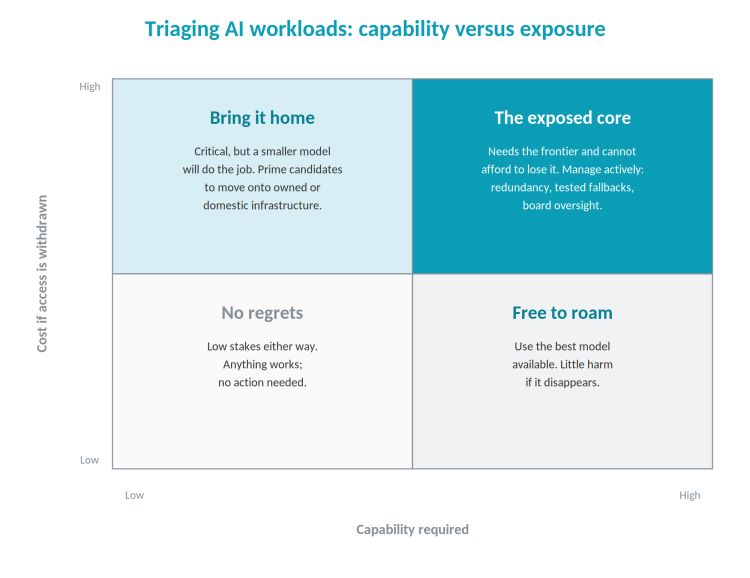
The right response is neither to retreat into “buy Australian” as a slogan nor to carry on as though nothing has changed. It is to triage your workloads. For each use of AI in the business, two questions matter:
• Does this task genuinely require frontier-level capability, or would a smaller, controllable model do the job?
• How much would it hurt if access vanished overnight?
Those two questions define four positions. Tasks that need little capability and matter little can run anywhere and need no attention. Tasks that matter a great deal but do not need the frontier are the prime candidates to bring onto owned or domestic infrastructure, where no foreign directive can reach them. Tasks that need the frontier but would not be missed if they vanished can sit on the best available model, with the risk knowingly accepted. The danger zone is the final quadrant; tasks that both demand frontier capability and would seriously damage the business if withdrawn. Those deserve active management, including redundancy across more than one provider where it is feasible, tested fallback plans, and a clear-eyed acceptance that some residual exposure cannot be engineered away.
This is now a governance question
The most important shift is in where this conversation belongs. For most organisations, the choice of AI model has been treated as a technical or procurement matter, generally settled well below board level. The Fable 5 episode shows why that is no longer adequate. When access to a capability the business depends on can be removed without warning by the decision of a foreign government, that is not an IT issue but is a strategic risk, and it belongs on the risk register and in front of the board.
The practical work is unglamorous. Inventory where AI sits in your operations, classify each use by the capability it needs and by the cost of losing it, and decide deliberately which exposures you are willing to carry. None of this requires building your own model. It requires treating model access as the strategic dependency it has now, unmistakably, been shown to be.
The frontier model can no longer be seen as a given. The sooner that is treated as a question of governance rather than one of technical convenience, the better placed a business will be when, not if, the next model goes dark.
 We are proud to have CBC Staff Selection as supporters of the Conus/CBC Staff Selection Trend Employment and Jobseeker data series