- Telephone
- Email

There’s been plenty written about the fact that the Participation Rate across Australia is at, or near, record highs and the effect this has had on suppressing unemployment rate declines, even as employment growth remains quite strong (see here for an example from the ABC a few weeks ago). The reason participation rates are so high is largely due to significant shifts in the participation of the female workforce where we have witnessed sharp increases in recent years. We have previously written pieces discussing the various drivers of Participation Rate changes and how we can calculate, and separate, them (see here and here for details) to give us insight into how and why participation rates have changed.
With the recent release of the July Conus/CBC Staff Selection Trend Employment data for Queensland we are able to update this regional analysis.
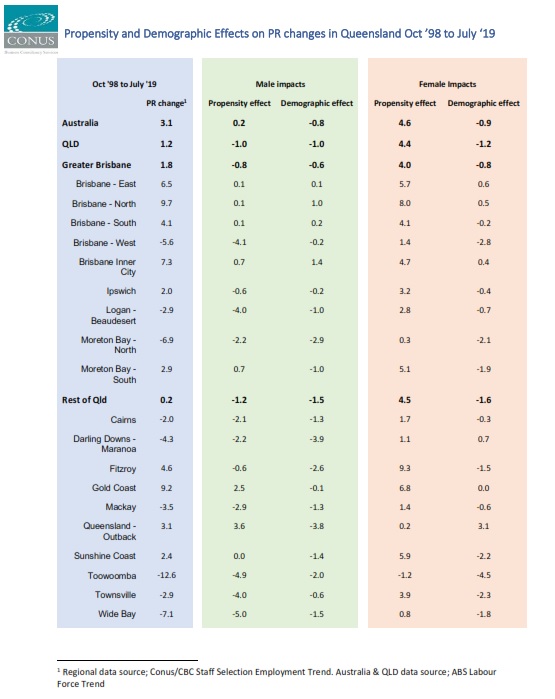
What our analysis shows us is that the changes driving record participation in Australia (a sharp increase in the propensity of females to enter the labour force while male propensity remains largely unchanged) have not been replicated in Queensland. In the Sunshine State, although participation rates are up over the 20 years of our study, the increase due to female propensity is a little less than nationally while male propensity has fallen in spite of a small rise nationally. This difference, combined with the negative effects of population age changes (which have been felt more in Queensland than nationally), sees Queensland participation rates having increased less than 1/2 as much as nationally.
Looking at the data more closely we see that participation in regional Queensland has barely increased at all. Although the propensity effect in the female work force has been of a similar scale to that seen nationally there has been a decline in male propsensity which, when combined with greater-than-average declines caused by population effects, has virually wiped out the improvemenst generally seen across the State.
The picture in differing regions varying enormously with some such as Gold Coast seeing sharp increases as propensity effects in both sexes were positive and the population effects were neglible (suggesting Gold Coast is something of a youth magnet). Conversely Toowoomba has seen negative propensity effects in both sexes and strongly negative population effects.
 We are proud to have CBC Staff Selection as supporters of the Conus/CBC Staff Selection Trend Employment and Jobseeker data series