- Telephone
- Email

The ABS released its 2025-26 wrap on overseas arrivals last Friday and the national picture is one of continued recovery. Short-term visitor arrivals to Australia rose 8% over the year to 9.10 million, a fifth consecutive annual rise, though still around 3% below the 9.3 million peak of 2018-19. Cairns is unfortunately not part of that recovery. Over the twelve months to July, international passenger movements through Cairns Airport fell 1.5% to 666,627. The monthly Trend, though, has turned hard in the other direction, and the gap between those two readings is the story.
Queensland is faring worse than the nation, not better. Short-term visitor arrivals to Queensland in June were 133,290, down 10.4% on June 2025, against a national fall of 9.2%. The State now sits 14.8% below its June 2019 level while Australia as a whole is 14.1% below. Queensland’s share of national visitor arrivals slipped to 23.5%, from 23.8% a year earlier. That is a small movement, but it is the wrong direction.
The weakness is concentrated rather than general. New Zealand is comfortably Queensland’s largest source market, accounting for 31.8% of all visitor arrivals to the State in June, and it fell 16.4% to 42,380. That one market accounts for 53% of Queensland’s entire year-on-year decline. The UK was down 23.6% and the USA down 12.7%. The clear positive is Japan, up 11.2% to 10,780 and the only major Queensland market above its 2019 level (+4.5%). For a region with direct Japanese services, that counts for more in Cairns than the State figure suggests.
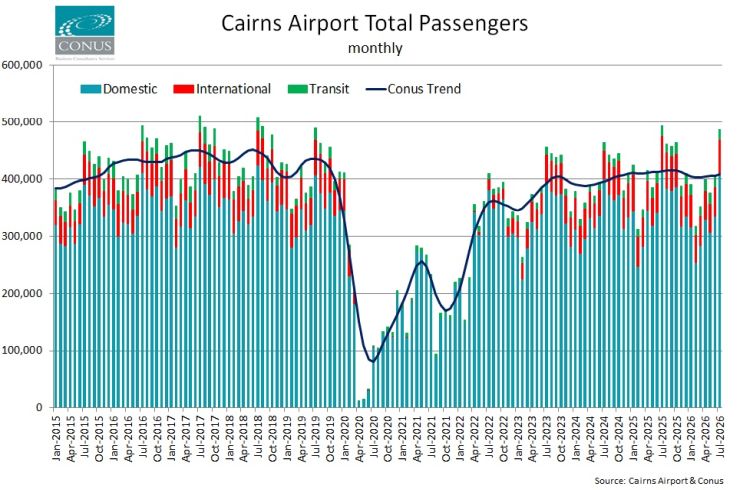
Cairns Airport published its July figures this week. July is the (supposed) start of the dry season and therefore one of the most informative months of the year. On the Conus Trend series, international passengers came in at 61,937, up 10.8% on July last year, a solid month taken on its own. Trend domestic is the softer half of the story: 334,849 passengers, unchanged from a year ago, and up just 0.2% across the rolling year. Trend total passengers of 412,824 was 1.6% above July 2025. Note the change of basis: the twelve-month figures above are raw passenger movements, these are Trend. The rolling year is still negative because the first half of it was weak. The recent direction of travel is not.
Volume is not the whole picture, and the value side is genuinely strong. TTNQ reports record international expenditure in Tropical North Queensland of $1.3 billion in the year to March 2026, up 27.6%, on visitor nights up 32.1% to 6.2 million and spend per visitor of $1,976. The visitors arriving are staying longer and spending considerably more, and that has been carrying the region. The question is how durable it proves: 2025-26 was the last year of Federal funding for international marketing, and the volume base underneath that spend figure has only just begun to recover.
One caveat worth stating plainly. These two series do not measure the same thing. The ABS counts inbound short-term visitor arrivals crossing the border in one direction. Cairns Airport counts international passenger movements through T1, arrivals and departures both, including returning Australian residents. The comparison here is directional. A true like-for-like regional read has to wait on TRA’s International Visitor Survey, where the data for the year ending the June quarter is not released until next month.
 We are proud to have CBC Staff Selection as supporters of the Conus/CBC Staff Selection Trend Employment and Jobseeker data series